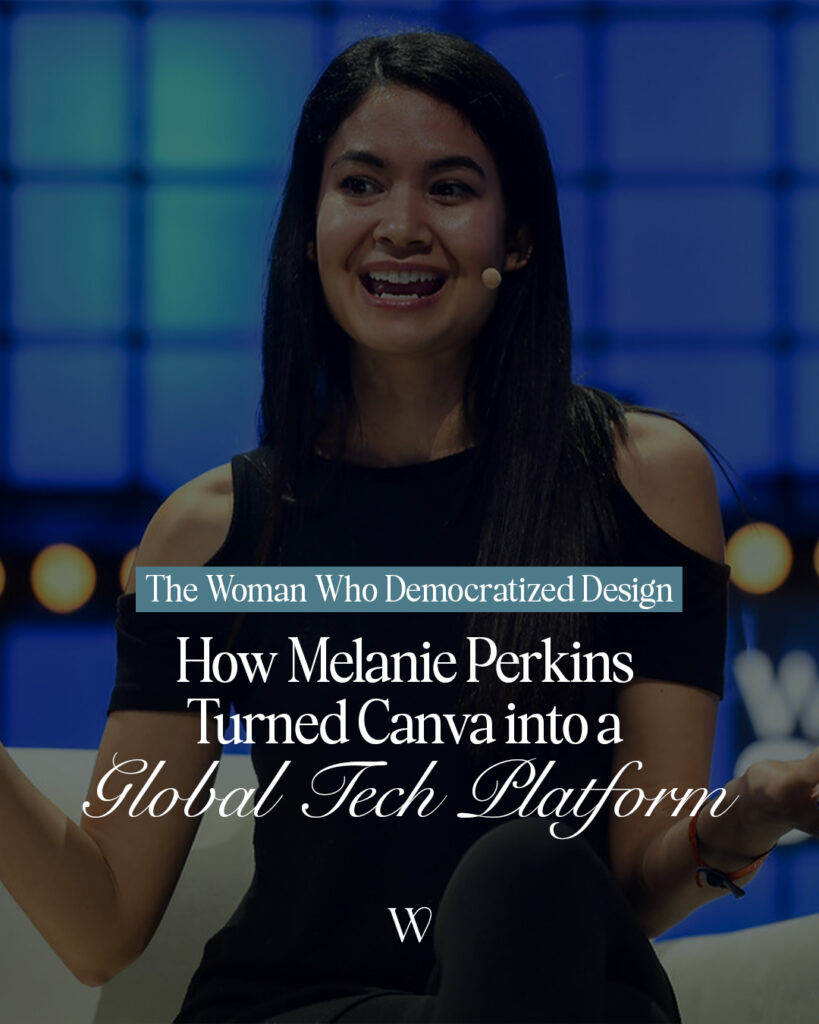

The digital world runs on visuals. Every presentation deck, social media post, pitch proposal, and marketing campaign relies on design to communicate ideas clearly and quickly. Yet for years, professional-looking design was locked behind complicated software that only trained designers could use. For many entrepreneurs, students, and small business owners, creating polished graphics meant either learning complex programs or hiring a professional.
That gap between creativity and accessibility is exactly what Melanie Perkins set out to solve.
As the co-founder and CEO of Canva, Perkins built one of the most influential creative platforms of the digital age. What began as a simple idea to make design easier has grown into a global platform used by hundreds of millions of people across more than 190 countries. In a world increasingly driven by digital communication, Canva has changed how individuals, teams, and businesses create visual content.
For women navigating careers in business, entrepreneurship, or technology, Perkins’ story offers valuable insight into how identifying everyday frustrations can lead to powerful innovation.
Seeing the Problem in Plain Sight
Melanie Perkins first noticed the design problem while she was still a university student in Perth, Australia. While studying communications and psychology, she worked as a tutor teaching students how to use traditional design programs like Photoshop and InDesign.
It quickly became clear that many students were not struggling because they lacked creativity. Instead, the tools themselves were difficult to learn. Even simple tasks required navigating numerous menus, commands, and technical features. Learning basic layout design could take weeks.
Perkins realized that the barrier to creativity was not talent, but accessibility. If design software were easier to use, far more people could create their own content without professional training.
That insight eventually became the foundation of Canva.
Starting Small: The Fusion Books Experiment
At nineteen years old, Perkins tested her idea by launching her first startup, Fusion Books, with her future co-founder and partner Cliff Obrecht. The platform allowed schools to design their own yearbooks online using templates and drag-and-drop tools.
Instead of relying on complicated design software, teachers and students could build layouts directly through a web browser. Fusion Books quickly expanded across Australian schools, proving that simplified design tools could work at scale.
More importantly, the experiment showed that when technology becomes easier to use, more people participate creatively. What began as a small startup for school yearbooks soon revealed the potential for a much larger design platform.
That concept eventually evolved into Canva.
Building Canva Against the Odds
Turning the idea into a global technology platform required persistence. Perkins spent years pitching Canva to investors and repeatedly faced skepticism. Many venture capitalists questioned whether simplified design software could compete with established creative programs that had dominated the market for decades.
She reportedly encountered more than a hundred rejections before securing the support needed to build the company.
Rather than abandoning the concept, Perkins continued refining the product and strengthening the business model. When Canva launched in 2013, the response was immediate. Users were drawn to its intuitive interface, ready-made templates, and drag-and-drop editing that allowed professional-looking graphics to be created in minutes.
What once required advanced technical knowledge suddenly became accessible to anyone with an internet connection.
The Strategy That Changed the Market
One of Canva’s most important strategic decisions was redefining the target audience for design software. Traditional design platforms focused primarily on professional designers. Canva focused on everyone else.
Students, entrepreneurs, educators, marketers, and small business owners suddenly had access to tools that allowed them to create high-quality visuals without specialized training. By expanding its user base beyond professional designers, Canva unlocked an enormous global market.
The platform’s emphasis on simplicity also became its greatest competitive advantage. Instead of overwhelming users with technical features, Canva prioritized intuitive design and user experience. Templates, customizable layouts, and drag-and-drop tools allowed users to produce polished visuals quickly.
As the platform grew, Canva expanded into a broader creative ecosystem. Teams can collaborate on presentations and marketing assets, businesses can maintain brand consistency using brand kits, and designers from around the world contribute templates and creative assets to the platform’s growing library.
Canva by the Numbers
A quick look at Canva’s global reach shows how dramatically the platform has expanded the design market:
- Used in 190+ countries worldwide
- Hundreds of millions of active users
- Billions of designs created on the platform
- Thousands of templates and design assets available to users
- One of the most valuable technology startups to emerge from Australia
These numbers reflect a broader shift in the digital economy. Creativity and visual communication are no longer limited to trained professionals. Accessible tools have allowed individuals, startups, and organizations of all sizes to produce high-quality visual content.
Why Melanie Perkins Matters in Tech
The global technology industry remains heavily male-dominated, particularly at the founder and executive levels. Melanie Perkins’ rise as the CEO of one of the world’s fastest-growing design platforms represents an important shift in that landscape.
Rather than focusing on building a celebrity founder persona, Perkins has emphasized product development, accessibility, and long-term growth. Canva’s strategy centers on empowering users and making creative technology approachable.
Perkins and her co-founders have also pledged to donate a large portion of their wealth through philanthropic initiatives, demonstrating how successful tech companies can contribute to broader social impact.
Her journey shows that leadership in technology does not always follow a traditional path. Innovation often begins with a clear vision, persistence, and the ability to rethink how existing tools can better serve people.
The WYLD Tech Takeaway
Melanie Perkins did not invent graphic design software. What she did instead was transform how people access it.
By simplifying complex technology, Canva opened the doors of creativity to millions of people who previously felt excluded from the design world. Students, entrepreneurs, content creators, and businesses can now communicate visually without needing specialized training.
In a digital landscape driven by ideas, visuals, and online storytelling, tools that make creativity accessible hold enormous value.
And sometimes the biggest tech breakthroughs do not come from making things more complicated, but from making them finally simple enough for everyone to use.
Sources:
- Melanie Perkins noticed students struggling with design software
- Financial Express article on Canva’s founding story
- How Melanie Perkins faced more than 100 investor rejections
- Origin story describing 100+ investor rejections
- How Canva focused on non‑designers and everyday users
- Profile on how Perkins refined her pitch after each rejection
Bio:
Paula Mae Caparic is a WYLD writer who can write about almost anything, especially if it sparks a question worth asking. Her work blends research, analysis, and personal insight, often with a sense of humor and a dash of sass.