
When you think of the iconic movie ensembles in the last few years, who do you think of?
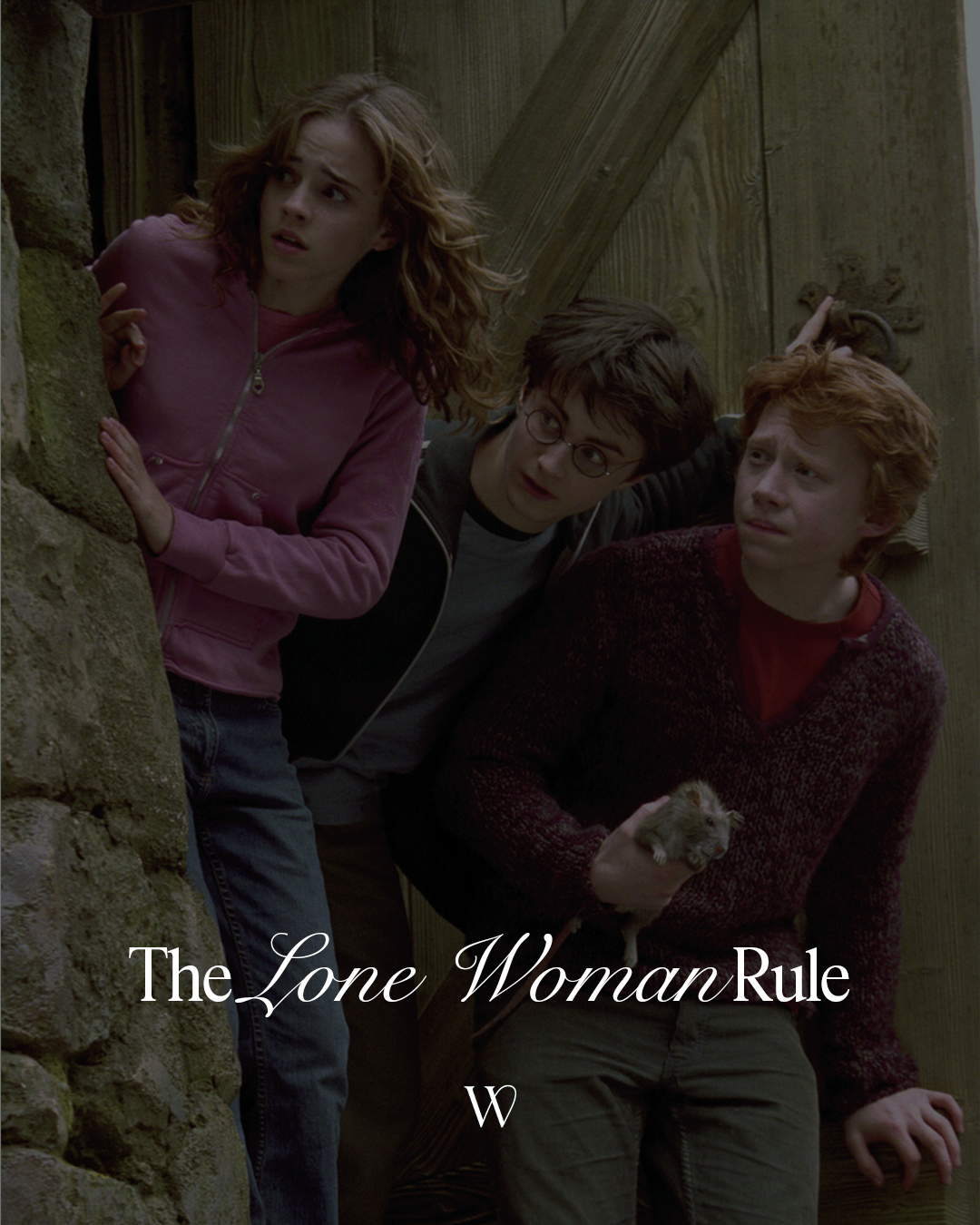
Do you think of Harry, Ron, and Hermione from The Harry Potter Series?
Do you think of The Avengers, made up of Captain America, Iron Man, The Hulk, Hawkeye, Thor, and the Black Widow?
Or do you think of Luke Skywalker, Princess Leia, and Han Solo from Star Wars?
Did you notice any pattern among these ensembles?
There’s only one woman. In all of them.
The ‘lone woman’ is a trope where a female character is depicted as the sole or primary female figure in a mostly male environment. The lone woman is usually shown as strong, independent, and ‘able to keep up with men,’ but often shows how their ‘woman-ness’ helps the male leads be more human and vulnerable.
The lone woman trope is also usually seen in media that’s targeted ‘universally.’
When a piece of media, whether it’s a movie, TV show, or book, has romance or relationships at its center, it’s targeted towards women. But when a movie is driven by action and adventure, it’s targeted towards men, the universal default.
“Boys are the norm, girls the variation; boys are central, girls peripheral; boys are individuals, girls types. Boys define the group, its story, and its code of values. Girls exist only in relation to boys,” poet and essayist Katha Pollitt observes in her The New York Times Magazine article on this very topic, which she dubbed The Smurfette Principle.
Take the Harry Potter series.
Harry is the story’s core, but his years at Hogwarts and beyond see him supported by his best friends, Ron and Hermione. Harry is portrayed as heroic, if a little bit naïve and impulsive. Ron is loyal, going along with Harry’s adventures with a wisecrack or two. Hermione is dubbed the brightest witch of their age, known for her wisdom that gets them through some sticky situations.
The trio’s friendship had a rocky start, with both Harry and Ron finding Hermione’s know-it-all behavior obnoxious. They go through harmless to dangerous adventures, welcome Hermione to their fold, and she’s seen as a core member of their friend group since then.
Though they work with many other wizards and witches throughout their journey to defeat Lord Voldemort, Hermione remains the only woman in their core group. We learn about Harry’s thoughts and motivations, but we don’t know much about Hermione beyond her relation to Harry and Ron. We wouldn’t even know about Hermione’s Time Turner and her own adventures if it weren’t needed for Harry’s mission to save his godfather!
The same applies to Black Widow from The Avengers.
As the only woman in a hero lineup of tech and science geniuses, soldiers, and literal gods, Black Widow is positioned as the only female representative. Since she doesn’t have superpowers like most of the male Avengers, she has more narrative pressure to prove herself as competent in comparison to the others.
The Black Widow also functions as the team’s heart, acting as Bruce Banner’s romantic interest, Captain America’s confidant, and as the team’s mediator, absorbing the team’s emotional labor with little to no return for her own emotional needs. She even sacrifices herself for the team come Avengers: Endgame, but unlike the demise of the other Avengers (i.e., Tony Stark), she barely gets any recognition or scenes highlighting how her sacrifice moved the team and the story forward.
Sure, the Marvel Cinematic Universe tries to fix some of these issues through later movies that expand on her own backstory. But her initial character function is to be the lone woman by design, with femme fatale aesthetics catered to the male gaze, and a controlled femininity that reinforces the idea that she’s a strong woman, but not as good as the men in the team.
And why should it matter if there’s always just one woman in an ensemble made up of mostly men?
Because this tokenization places a responsibility on the lone woman character to represent the female population, and they’re often forced to be one-dimensional characters, functioning either as the default confidant, the distressed romantic interest, or the maneater.
This lone woman representation also invites a more dangerous phenomenon of the ‘pick me girl.’ If women have to fight to be the only one in the room, then a tendency to perform or please the men takes precedence over being a girl’s girl or showing up for her own gender.
The lone woman, when portrayed as strong and fierce, is also prone to shunning her femininity to be accepted into the boys’ club. Often, the lone woman has to build her guard up, distance herself from girly things, or act antagonistic with other female, more feminine characters. To be one of the boys, they almost always have to be unlike every other girl. And that’s a problem.
There are ways to lessen the lone woman trope, such as the Bechdel test.
A measure of female representation coined by cartoonist Alison Bechdel, the Bechdel test follows the following criteria: the media must have at least two women in it, where they talk to each other, about anything other than a man.
While the Bechdel test doesn’t guarantee that female characters will be well-developed, it’s a useful tool to highlight the inequality in gender representation in media. For a test so simple, the 2025 data of the Bechdel Test Movie list shows that only around 57% of films released pass the test. And surprisingly enough, it’s the romance genre media that pass the test most frequently.
For all their magic, superpowers, and epic stakes, popular movies keep repeating the same pattern: one woman surrounded by men, expected to represent half the population. From Hermione in Harry Potter to Black Widow in The Avengers, the lone woman trope limits not only female characters but the stories themselves, reinforcing the idea that men are the default and women the exception.
When barely over half of films can pass the simple Bechdel test, this is not a minor critique but a cultural imbalance. If stories shape how we see the world, then who gets to fully exist within them matters. It’s time for ensembles where women are not tokens, but fully realized characters who share the spotlight.
Sources:
- https://www.thecourieronline.co.uk/the-lone-girl-theory-why-women-in-film-are-always-alone/
- https://exepose.com/2025/11/07/the-lone-woman-how-film-tropes-tokenise-female-characters/
- https://www.nytimes.com/1991/04/07/magazine/hers-the-smurfette-principle.html
- https://bechdeltest.com/statistics/
Bio:
Sanne is a marketer by profession and a writer by passion. When she’s not working, she’s either working through her TBR pile, planning her next trip, or forcing her cats to cuddle.